Soaring college tuition and student debt, along with fears of AI replacing entry-level jobs, are causing this generation to reconsider their career goals. The data support these fears and have led many young people to ask, “Should I consider trade school instead of a 4-year college degree?”
To answer this question, The Hourglass Foundation provides a list of pros and cons of Trade School vs. College to help you decide the right path for you.
Fortune Magazine reports that students view degrees as “useless” because the unemployment rate for men ages 22 to 27 is the same with or without a degree. As a result, many young men and women are choosing to pursue skilled trades certifications and are bypassing college.
However, before deciding, let’s explore what trade school is and what to expect in a 2-year trades program.
What is a 2-Year Trade School?
Trade schools, technical schools, and vocational colleges are used interchangeably to refer to training that requires specialized education. Students can choose from various focus areas, including HVAC, automotive, plumbing, electrical, construction, and more. Trade schools can be public or private, and many programs are offered through community colleges. Students must have a high school diploma or GED and typically maintain a minimum 2.0 GPA to apply.
Pros/Cons of Trade Schools
- More affordable than traditional four-year degrees.
- Shorter training timelines.
- Faster entry into the workforce.
- High demand for skilled workers.
- Job security.
- According to Forbes, trade graduates are more likely to start their own businesses within the first decade of work experience compared to Bachelor’s degree graduates.
- Physical Demands.
- Certain trade positions may have lower long-term earning potential when compared to professions that require a bachelor’s degree.
- Potential for irregular hours or high travel may be required. Think emergency calls, evening shifts, or working on the weekends.
What is a 4-Year College Degree?
A Bachelor’s degree (College or University degree) typically requires about four years to complete. It combines general academic courses like science, math, and English with a focus on a student’s chosen major. A major is a student’s primary field of study, such as Communications, Business, Psychology, or Healthcare, in which a student can earn a degree.
Pros and Cons of a 4-Year College Degree
- Offers learning on diverse topics to create a broader understanding of the world and improve critical thinking skills.
- Networking opportunities with faculty, career services, and alumni associations.
- Higher income potential exists through degrees in fields like Law, Healthcare, and Engineering, which are exclusively offered at colleges.
- Career flexibility. A broad education can provide various skills transferable to different industries.
- Most careers have structured schedules with predictable hours, like an eight-hour workday and a one-hour lunch break, Monday through Friday.
- If you are uncertain about your talents, college can help you discover what suits you.
- According to the Education Data Initiative, the average cost for students earning a bachelor’s degree has more than doubled. When you calculate student loan interest rates and lower salary income, it can cost upwards of $500,000.
- On average, it takes four years to earn a degree compared to completing a two-year program at a trade school.
- According to the Federal Reserve Bank of New York, the unemployment rate among recent college graduates is approximately 5.7%. Compared to vocational and community college graduates, unemployment is lower at 2.1%, according to the U.S. Bureau of Labor Statistics.
- May involve strict office schedules or location-based work environments.
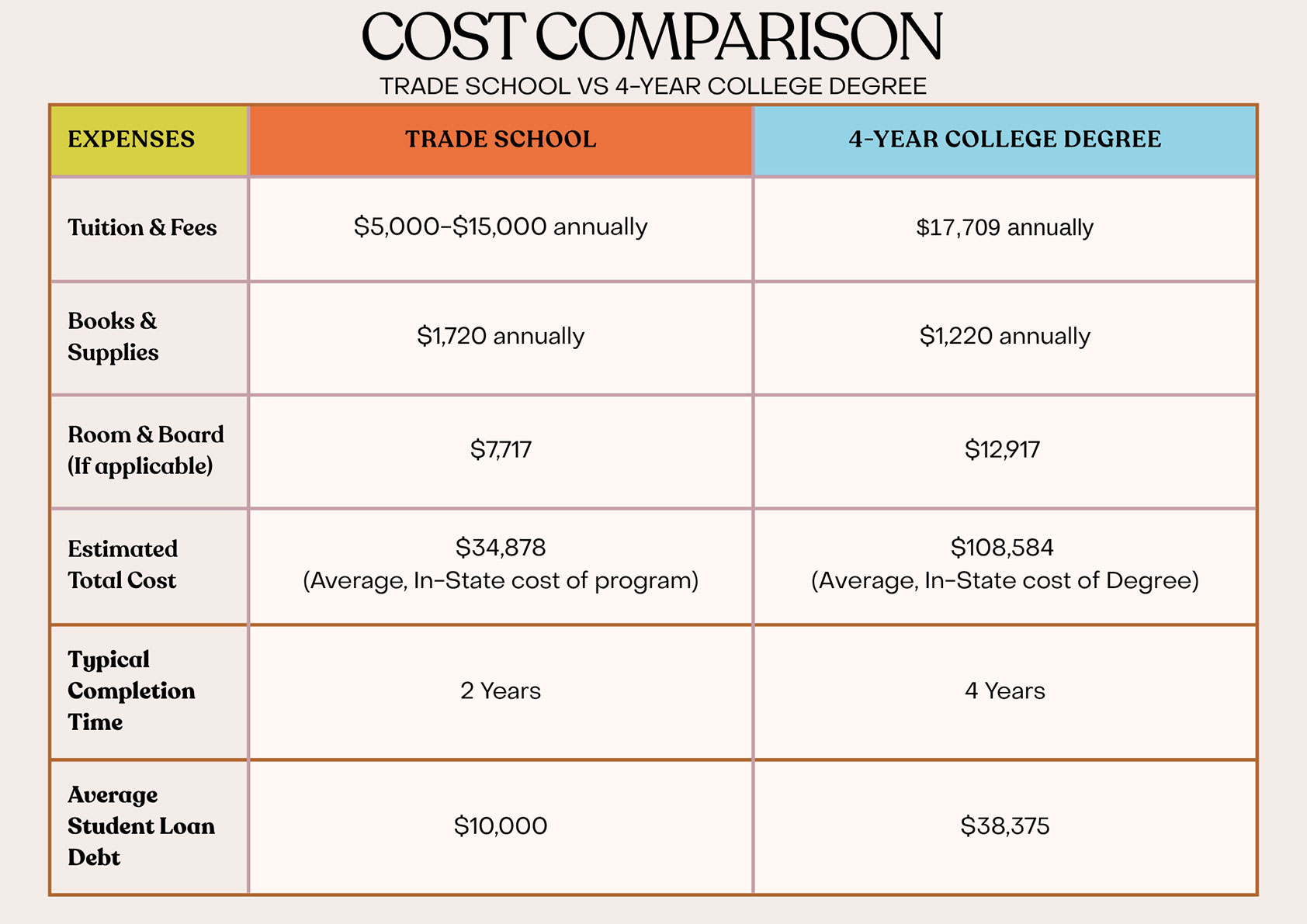
Sources:
Data compiled from Education Data Initiative’s
“Average Cost of College,”
Edvisors’
“How Much Does Trade School Cost?,”
and BestColleges’
“How Much Does Trade School Cost?.”
Costs are approximate national averages and may vary by institution and geographic location.
Workforce Demand
The demand for skilled trade workers is increasing rapidly due to a shortage caused by older generations retiring, a push towards green energy, and the construction of new AI data centers. This demand is not dwindling any time soon. For example, McKinsey & Company forecasts that roles such as welders, construction workers, electricians, and other skilled trades will see an increase in net new jobs, more than 20 times the annual average from 2022 to 2032.
McKinsey & Company forecasts that roles such as welders, construction workers, electricians, and other skilled trades will see an increase in net new jobs, more than 20 times the annual average from 2022 to 2032.
Many industries are currently struggling to replace experienced workers who are retiring. For years, young people were encouraged to earn college degrees, leaving a gap in trade careers that organizations cannot fill. As a result, there are mass shortages in fields such as plumbing, HVAC, automotive technology, manufacturing, and construction. The demand for skilled workers is more prominent than ever.
Additionally, the rise in renewable energy projects, electric vehicle manufacturing, and AI data centers all require skilled trades professionals. AI is eliminating many entry-level jobs, but skilled trades still need manual labor and quick decision-making that machines cannot replicate.
Questions to Ask Yourself Before Choosing
Before deciding what school, program, or degree to pursue, ask yourself the following questions:
What kind of job am I looking for?
Some careers require a bachelor’s degree while others can only be found in niche programs. Imagine your day-to-day life. Can you picture yourself commuting to an office? Or do you envision a more hands-on, travel-based career that is more common with skilled trades?
How much can I afford to spend?
For many students, the burden of responsibility falls on their shoulders. How much debt are you willing to take on to achieve your career goals? When deciding, keep this in mind, as costs vary depending on the type of education you want.
Students should research financial aid and scholarship options, whether they attend college or trade school, to help reduce student debt. The Hourglass Foundation supports students enrolling in skilled trade programs through scholarships designed to make career training more accessible.
How do I determine the ROI (Return on Investment) of an apprenticeship or a degree?
Research average salaries of potential careers, demand for them, and a variety of schools that offer programs in your area to determine if the student debt is worth the investment for your future.
Am I looking out for my best interest, or the interest of others?
You only get one life! Ensure your decisions come from your own talents and interests, not from external influences or societal pressures. Public perception is fickle and can change quickly. Choose what is best for your lifestyle rather than focusing on outside perspectives.
Would I prefer hands-on training or more theoretical learning?
If you enjoy lectures, research, and academia, a university may be the right fit. If you get a kick out of fixing, building, or creating with your hands, trade school may be a great option.
Conclusion
Whether choosing a skilled trade or a college degree, the key is to seek education that aligns with your career goals. The Hourglass Foundation supports students pursuing meaningful careers through scholarships and advocacy for skilled trades education.
Our foundation believes that everyone deserves the opportunity to achieve their career goals through hard work and commitment. We support trade school and community scholarship programs to create a better future for students and communities.